Why Tile Retailers Need Visualization Software to Reduce Buyer Uncertainty
4 Min Read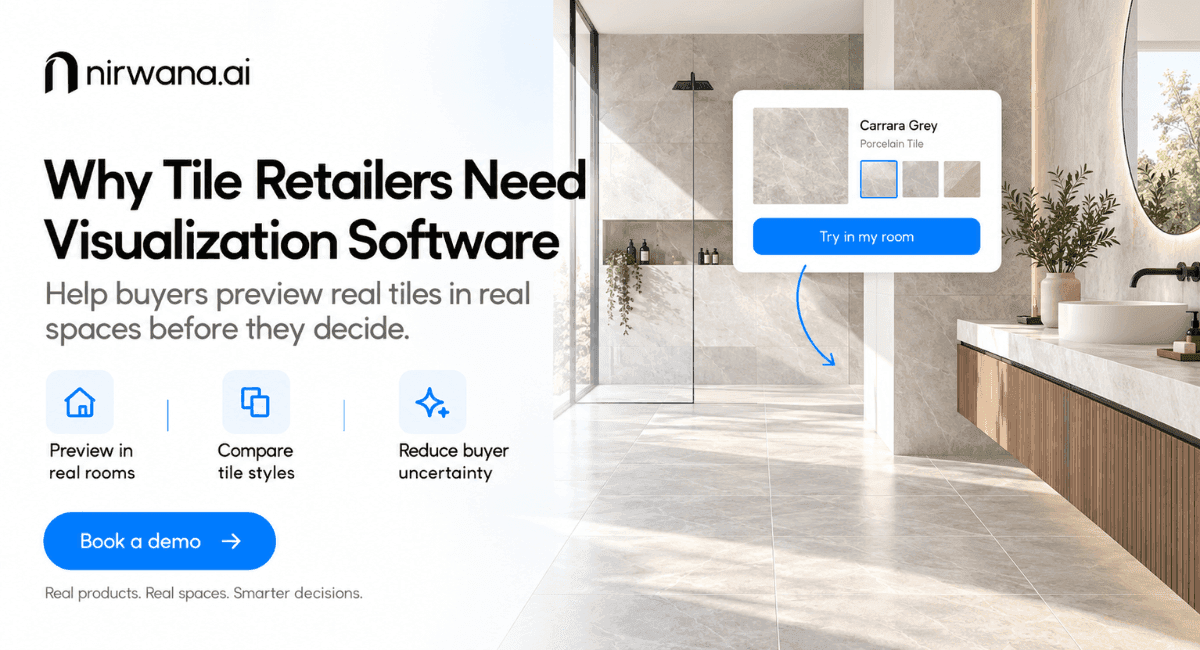
October 22, 2026
Choosing tiles looks simple until the customer has to make the final decision.
A tile may look beautiful on a sample board. The colour may feel right. The finish may match the style of the room.
But customers still ask the same questions:
Will this tile look too busy across the entire floor?
Will the colour look different in my room?
Will this pattern actually work on a large wall?
That uncertainty is one of the biggest challenges tile retailers face.
Customers are not only choosing a product. They are trying to imagine hundreds of tiles installed together across a real space.
This is where tile visualization software for retailers can make the buying process much easier.
In Nirwana AI, we assist tile manufacturers and retailers to convert a sample of their product into a realistic representation of a room, enabling users to make informed choices.
Why Tile Buying Creates So Much Uncertainty
You can't get a true impression of tiles from a photograph or small sample.
A 600x1200 tile can be vastly different when applied to a huge floor or wall.
Customers worry about:
Whether the pattern will feel too repetitive
Whether the tile will make the room look darker
Whether the format is right for the available space
Which laying pattern will look best
How grout will affect the final appearance
The tile's fit with the room lighting will be determined.The fit of the tile to the lighting in the room will be determined.
That is why numerous customers continue to request more samples, take pictures, take screenshots, check out various showrooms and postpone the purchase.
This is a longer sales cycle and a greater hesitation to buy for the retailer.
Tile Buying Behaviour Is Changing
Today's customer wants to see the outcome before committing.
They are already used to previewing products digitally in many other industries. The same expectation is now entering tile retail.
Instead of simply looking at a tile and trying to imagine the result, customers want to upload their own space and see the actual product applied inside it.
That is the role of tile visualization software.
The buying conversation changes from:
"I think this tile should work."
to:
"I can see how this tile looks across my actual floor."
The change is important because confidence is a primary factor that can push customers to buying.
How Nirwana AI Works for Tile Brands and Retailers
Nirwana AI enables brands and retailers to integrate their actual tile catalogue with the power of AI and create a visualization experience.
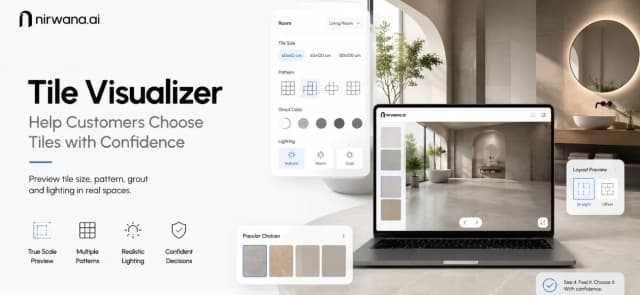
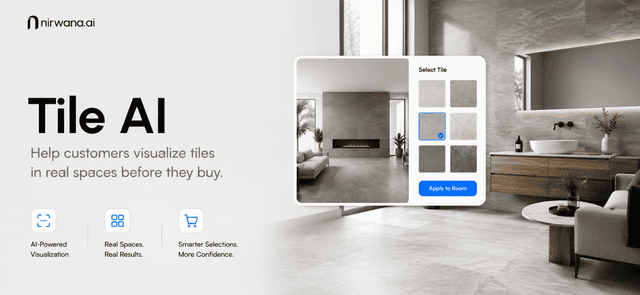
A customer can upload a picture of their room or pick a space from a set of pre-defined spaces, select a tile from the catalogue and see how it will look on the corresponding space.
Not to create a new design for the whole room.
The intent is to educate the customer about the actual tile.
True-Scale Visualization
Tile size matters.
A large format tile cannot just be presented as a repeating texture, with no connection to the actual room.
True-scale visualization with Nirwana AI helps customers grasp the proportions, repetition and coverage of tiles.
This helps to minimize the difference between the digital preview and the actual installation.
Pattern Alignment
The layout of tiles can completely transform the nature of a space.
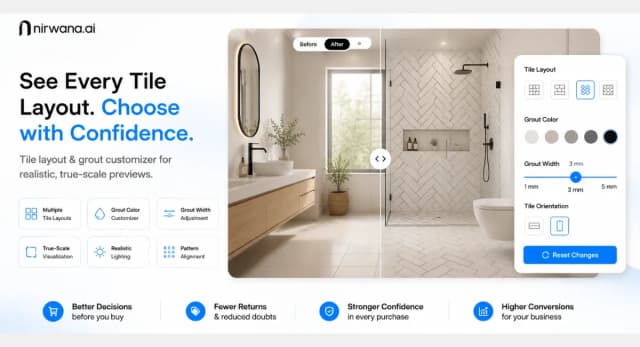
Different grid patterns, like straight grid, stacked, offset and more can produce very different effects.
By using different tile software from brands, customers can not only know what tile they like, but also know that the selected tile layout will affect the whole room.
Realistic Lighting
A tile that looks great in strong light in the showroom might turn out to be quite different in a customer's home.
All light (natural or artificial), colors, and shadowing impact perception.
Nirwana AI strives to maintain the room's ambiance and lighting as realistically as possible to ensure a more believable visualization.
Automated Texture Mapping
Manual application of a room image is time consuming for tile.
The selected tile placement and surface detection using AI, combined with automated texture mapping, ensures that the chosen tile is placed naturally over the relevant surface, while keeping the perspective and room structure intact.
This is much easier to be visualized for brands that have a large product catalogue.
Practical Use Cases for Tile Retailers
Suppose a customer comes to a showroom and has three tiles shortlisted.
The salesperson can assist the customer to preview all three sample boards in the customer's own room, rather than moving samples around the showroom.
The customer can compare them side by side, and make an informed decision.
For online stores, it can be a feature of their website.
When a customer is looking around a tile showroom, they can choose a tile and upload a room of their own and see how it looks before asking for a quote or coming into the store.
Manufacturers can leverage tile visualization software throughout their dealer networks, on their websites, by their salespeople, and on their showroom displays – all with a consistent product catalogue and visual experience.
The key to better buying decisions is better visualization.
There's no need for customers to have more tile images.
They need to have greater certainty.
For retailers, a good tile visualization software can make the difference in helping customers visualize what the tile can look like in a full room after it is purchased in a small sample.
This can lead to more interesting sales discussions, more knowledgeable customers and fewer “sounds good in my head” purchases for retailers and brands.
At Nirwana AI, we are building visualization around a simple idea:
Help customers see the finished space before they commit to the tile.
If your tile brand or retail business wants to make product selection more interactive and reduce buyer uncertainty, book a demo with Nirwana AI and experience AI-powered tile visualization.