Tile AI: How AI Visualization Is Changing the Way Customers Choose Tiles
4 Min Read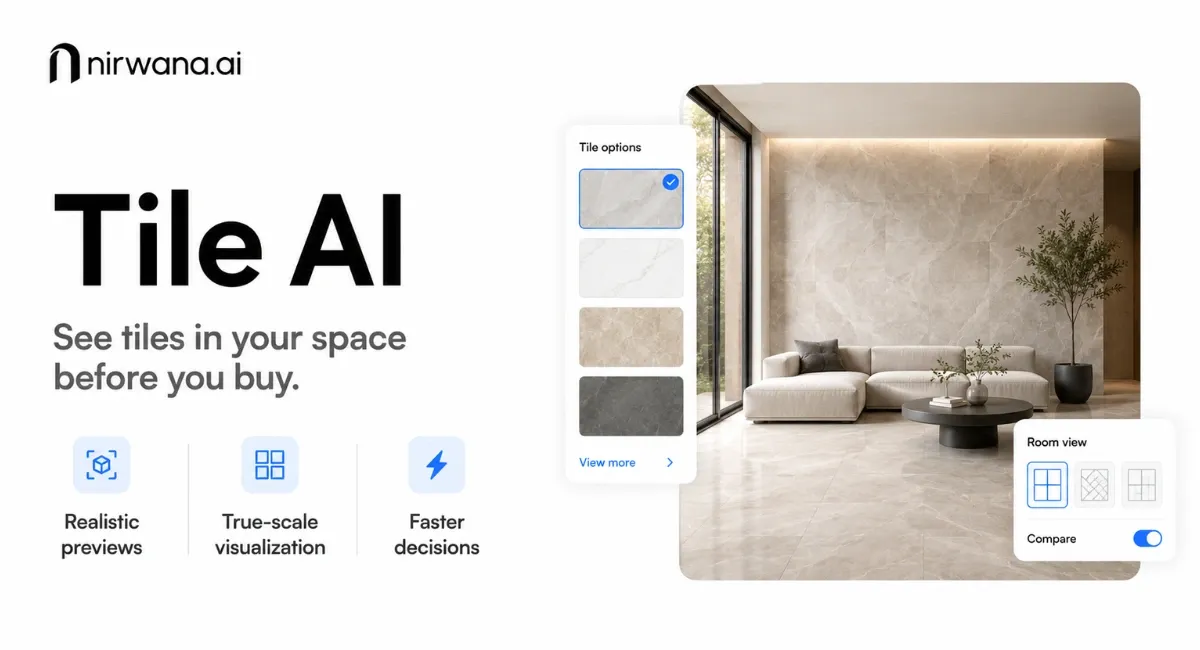
July 6, 2026
Choosing the tile can be a straightforward task, but knowing the complexities of it, will be realized if someone actually chose the tile.
The customer needs to consider colour, size, finish, pattern, grout, layout, lighting and how the tiles will appear after they have been installed on a whole wall or floor. A beautiful sample tile can look very different when installed in a huge room.
It is one of the largest problems faced in the tile business. Accessible and tactile to the customer, but it is still not clearly seen and felt what the final product will look like.
That's where Tile AI steps in.
Customers can view selected tiles in a realistic space before buying with an AI-powered tile visualizer. They can now experiment with what various combinations of tiles and size, pattern and layout might look like in a room without having to make mental calculations.
We at Nirwana AI make the product catalogues interactive, visual experience for tile brands. This simplifies product exploration, comparison, and better customer decision making.
The Real Challenges Tile Brands Face
There are much more varieties of tiles available now than ever. The same collection can be available in multiple colors, sizes, texture, finish and patterns.
More variety is great for the customer but can make it a difficult decision to make for the customer.
For instance, a customer might adore a tile that has a marble look in a small tile sample but be concerned that the veining pattern will be too cluttered on the entire floor. One user may desire an ornamental pattern tile, and be uncertain how the same tile will look in a complete bathroom wall.
Brands, dealers, and retailers of tiles often face issues like:
Customers struggling to imagine the finished room
Large product catalogues becoming difficult to explore
Small samples failing to show the complete design
Confusion about tile dimensions and proportions
Difficulty comparing several tile options
Longer decision-making cycles
Dependence on physical mock-ups or manually created renders
Traditional catalogues and product images can provide inspiration, but they usually show only a small selection of products. For a tile brand with hundreds or thousands of designs, creating a separate room render for every product is expensive and time-consuming.
A tiles visualizer helps solve this problem by allowing more products to be explored in realistic room settings.
How Customer Buying Behaviour Is Changing
Today's customers are not satisfied with a product image and technical spec. They would like to see what a tile will look and feel like in their space before ordering.
A majority of buyers are already on their way digitally. They look through collections, compare products, save images to reference, and share options with family members, architects or interior designers.
But lots of people get hesitant when they can not clearly envision the completion of the installation.
Tile AI helps move customers from simple browsing to confident decision-making.
Suppose that a person has to choose floorings for the living room. The three choices they make are a light stone-look tile, a dark concrete-style tile, and a large-format marble-effect tile.
The old-fashioned way they can take samples home, put them on the floor and visualize how each solution will appear across the room.
The customer is able to upload a picture of the living room, and the visualizer of the tiles will show the customer the three tiles applied to the floor to let him/her compare the results in seconds. This simplifies the purchasing process, makes things more visual and easier to understand.
The Benefits of AI-Powered Tile Visualization
AI-powered visualization brings together speed, realism, and product accuracy. It helps customers understand what they are buying while helping brands present products more effectively.
Realistic Tile Previews
A useful visualization should do more than place a flat tile image over a room photograph. The product should feel naturally connected to the original environment.
Nirwana AI considers the perspective of the room, visible surfaces, existing furniture, and lighting conditions to create a realistic preview.
This helps customers see whether the selected tile suits the room as a whole instead of judging it as an isolated sample.
True-Scale Visualization
A tile's size could truly effect the entire appearance of a room.
Combinations of size and shape create various appearances: 600×600 mm tile, 600×1200 mm tile, large format slab tile. There can be more or less joints depending on the tile size, whether they are visible or not, the pattern size (scale) applied and the space size.
The actual product measurements are used to show the tiles with the correct visual scale in Nirwana AI. This will help customers realize how many tiles they will be purchasing for a wall or floor and if the format will fit the room.
Better Pattern Alignment
Geometric, directional, decorative and marble-looking tiles require special care in repeating.
If the texture map is incorrect, the pattern might appear "stretched," "misaligned" or even "unrealistic. This may result in the misrepresentation of the actual product.
In addition to mapping tile patterns across wall and floor surfaces, Nirwana AI maintains perspective, proportion, repetition and alignment. It's particularly helpful for tiles that have veins, designs, or patterns on them that go in a certain direction.
Lighting-Aware Visualization
Lighting around a tile can make it entirely different when compared to another place it may be used.
A tile may appear to be brighter in a showroom, warmer under artificial light or softer under natural light.
Nirwana AI automatically adjusts the preview as per the light in the room image uploaded. This results in something that seems realistic, but does not alter the original tile design.
Automated Texture Mapping
Designing individual lifestyle renders for each product is quite a task and time consuming.
Automated texture mapping enables tile companies to process their product photos to make them into visual materials more efficiently. This means that more products can be made available for visualization without having to manually create a room scene for each and every tile.
It also enables brands to introduce new collections quicker and also to make their whole clothing catalog interactive.
How Nirwana AI Works for Tile Brands
Nirwana AI can be added to a tile brand’s website, dealer platform, showroom touchscreen, kiosk, or digital sales process.
The customer begins by selecting a tile from the catalogue. They can then choose a preset room or upload a photograph of their own space.
The system identifies the relevant wall or floor and applies the selected tile while maintaining the correct scale, perspective, pattern, and lighting.
Customers can compare different products, explore layout styles, change tile orientation, and save or share their preferred visualizations.
For a tile retailer, this can improve showroom conversations. Instead of showing customers only physical samples, the sales team can help them see how different options may look across a complete room.
For manufacturers, a tile visualizer can make online product discovery more engaging. Visitors no longer have to scroll through static product images. They can interact with the collection and see the products in real spaces.
Important Features and Business Benefits
Nirwana AI offers tile-specific features such as:
Automatic wall and floor detection
Customer room-image uploads
Ready-to-use interior spaces
Accurate tile-size visualization
Multiple tile layout options
Rotation and orientation controls
Grout colour and width options
Pattern repetition and alignment
Lighting-aware room previews
Save, share, and download functionality
These features offer practical benefits for tile businesses.
Customers can shortlist products more quickly. Sales teams can explain tile collections more clearly. Brands can provide a more interactive experience across both websites and physical showrooms.
Visualization can also reduce the gap between customer expectations and the final installation. When buyers understand the scale, pattern density, grout appearance, and tile layout before purchasing, they are more likely to feel satisfied with their choice.
Tile AI Use Cases Across the Industry
A tile manufacturer can use Nirwana AI to introduce a new collection with realistic previews for every design.
A multi-brand retailer can allow customers to compare tiles from different collections inside the same room.
A dealer can use a showroom touchscreen to help customers explore different wall and floor combinations during the sales conversation.
An online tile store can add a “View in Your Space” feature to its product pages. This enables visitors to get to know the product and get further into the buying process without having to visit a showroom right away.
This same technology can also assist architects, interior designers, contractors and sales rep's who often have to present tile options to their clients.
Conclusion
Customers do not only want to see a tile. They want to understand how it will look once it becomes part of their room.
Tile AI closes the gap between a small product sample and a complete installation. It provides customers with realistic previews, true scale visualization, accurate pattern alignment, lighting-aware results, and provides a better comparison of products.
Nirwana AI allows tile brands to make the buying process more interesting, boost customer trust, assist their sales teams, and even help customers navigate large product libraries with ease.
Ready to change the way customers discover and choose your tiles? Book a demo with Nirwana AI and turn your tile catalogue into an interactive visual experience.


