Furniture Visualizer: Why Furniture Brands Are Adopting AI-Powered Visualization Faster Than Ever
4 Min Read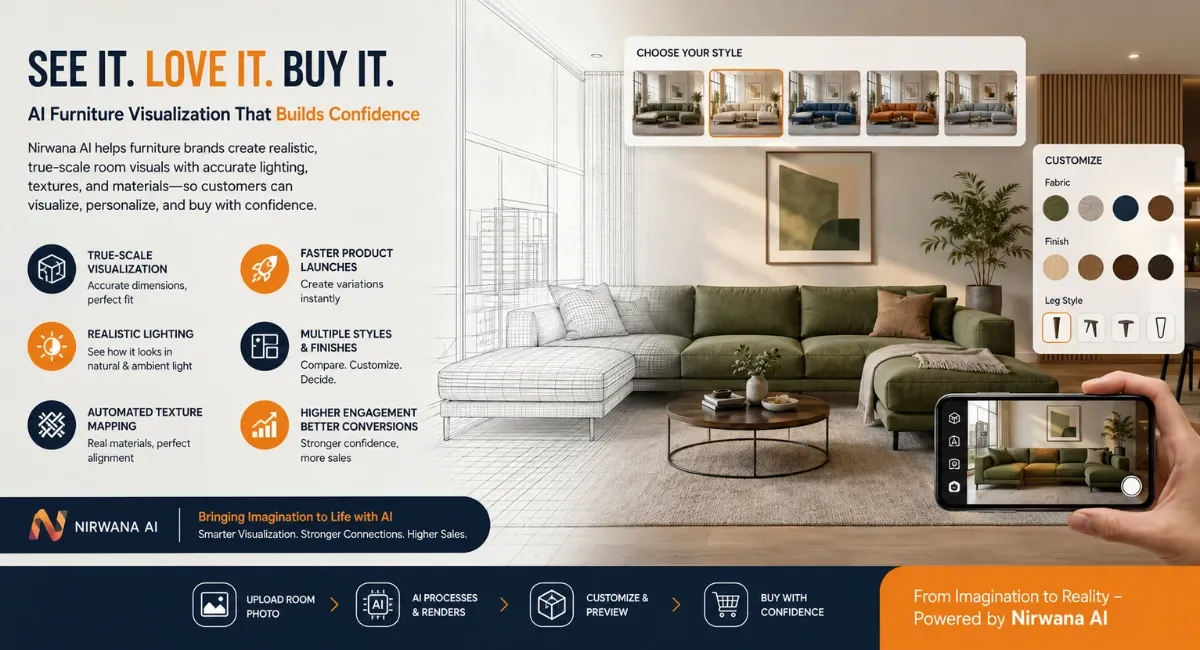
May 12, 2026
The furniture industry is always considered to be one of the major areas of imagination. Individuals visit a show house, glance at a catalogue or a website and think of a sofa in their living room, an eating table, a wardrobe or lounge chair, etc. That gap between imagination and confidence is where most furniture sales are either won or lost.
Today, that challenge is being solved through advanced furniture visualizer technology powered by AI.
Modern customers no longer want static product photos. They expect immersive, personalized, and realistic buying experiences before making a purchase decision. This is exactly where an ai furniture visualizer changes the game for furniture manufacturers, retailers, and interior brands.
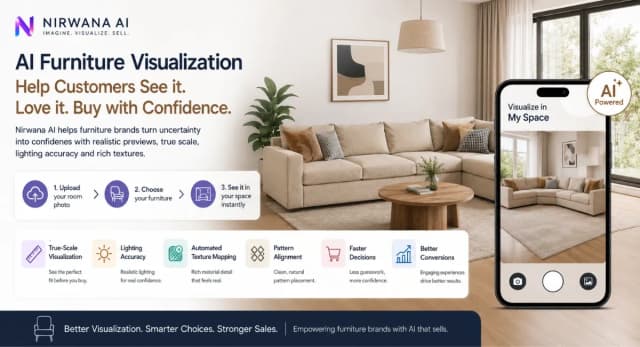
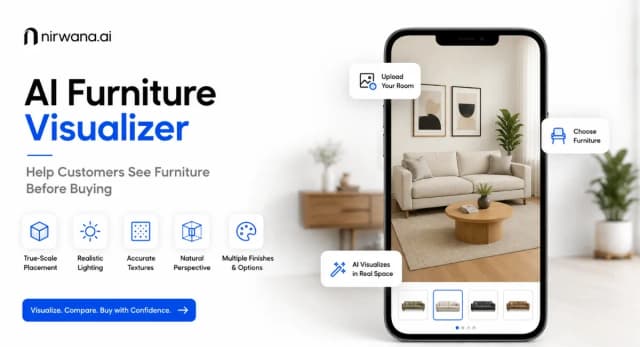
At Nirwana AI, furniture companies can leverage AI to create photorealistic images of their products in various rooms, with proper scale and placement, and realistic textures and lighting. No more making a guess as to how furniture will look in someone's home; customers can now see exactly how it will appear from the comfort of their own home.
Consequently, the buying journey is smarter, engagement is increased, decisions are made more quickly and conversions are boosted.
The Biggest Challenge in Furniture Retail: Customers Cannot Visualize the Final Look
One of the most visualization dependent industries in the world is furniture.
Furniture affects the whole room, its appearance, flow and emotional tone, unlike small consumer products. However, buyers wish to be sure before making high-dollar purchases.
But traditional furniture selling methods still create major friction points:
Static product images lack context
Studio photos rarely match real customer homes
Customers struggle with scale and proportion
Fabric colors appear different under varying lighting conditions
Furniture finishes may look inconsistent online
Product catalogs fail to create emotional confidence
Return rates increase because expectations don’t match reality
For example, a customer purchasing a premium sectional sofa online may love the product image but hesitate because they cannot tell:
Will it overpower the room?
Will the fabric work with warm lighting?
Does the wood finish match their flooring?
Is the sofa proportionate to the available space?
Will the color feel darker in a compact apartment?
All these uncertainties delay the buying process.
That's why the use of AI-powered 3d furniture visualization is increasingly becoming a necessity for today's furniture companies.
Buying Behaviour Has Changed: Customers Expect Interactive Visualization
Furniture shopping is no longer linear.
Today’s buyers move across multiple channels before making a purchase:
Instagram inspiration
Pinterest mood boards
Marketplace browsing
Brand websites
Virtual consultations
Online catalogs
Mobile-first shopping experiences
During this journey, customers expect brands to provide interactive tools that reduce uncertainty.
Modern buyers want to:
Visualize furniture inside realistic room scenes
Compare multiple finishes instantly
Test different upholstery materials
Explore layouts digitally
Understand dimensions visually
Preview products under natural lighting conditions
Traditional photography alone cannot meet these expectations anymore.
This shift is why leading furniture brands are investing heavily in ai furniture technology to create immersive digital experiences.
AI visualization is no longer a luxury feature. It has become a competitive advantage.
Why AI Furniture Visualization Is Becoming Essential
The biggest strength of an advanced furniture visualizer is realism.
Customers no longer want “conceptual” previews. They want accurate, believable room simulations that mirror real-world conditions.
This is where AI-powered visualization delivers massive value.
Instead of manually staging every product variation through expensive photoshoots, AI can instantly generate realistic room environments using automated rendering and intelligent texture application.
At Nirwana AI, we help furniture brands achieve this through:
Realistic room rendering
Automated texture mapping
True-scale furniture placement
Intelligent perspective correction
Material accuracy
Lighting-sensitive visualization
Pattern alignment consistency
The outcome looks realistic and believable.
For instance, an online furniture company might demonstrate:
Matte vs glossy finishes
Walnut vs oak textures
Different handle styles
Multiple room layouts
Daylight and warm-light scenarios
Without having to have dozens of photo shoots.
This significantly cuts down on operating expenses and enhances customer trust.
How Nirwana AI Transforms the Furniture Buying Journey
At Nirwana AI, we designed our platform specifically for industries where visualization directly impacts purchasing decisions.
Furniture is one of the strongest examples of this transformation.
Our AI-powered system allows furniture brands to create realistic visual experiences that help customers confidently move from browsing to buying.
1. True-Scale Furniture Visualization
Inaccurate scale perception is among the top consumer complaints.
A sofa can look as small in an online image as it can look as large in a real apartment. At first, a dining table might sound like the perfect solution but when they see how it is going to affect the ability to move around the room, they may reconsider.
Nirwana AI solves this with true-scale visualization.
Our system accurately places furniture according to room dimensions and perspective, helping buyers understand:
Spatial balance
Furniture proportions
Walking space
Layout harmony
Product fit
This improves confidence and reduces post-purchase dissatisfaction.
2. Lighting Accuracy That Reflects Real Environments
Lighting dramatically changes how furniture materials appear.
Fabric textures, wood grains, leather finishes, and color tones can look entirely different under daylight, warm ambient lighting, or cool LED settings.
Traditional product photography cannot fully represent these variations.
Nirwana AI uses intelligent lighting adaptation to generate highly realistic room scenes that reflect actual environmental conditions.
For example:
Cream upholstery appears softer under warm lighting
Walnut textures maintain realistic depth
Velvet surfaces reflect light naturally
Matte finishes avoid artificial shine
This realism helps customers trust what they see.
3. Automated Texture Mapping for Furniture Materials
Furniture products involve highly detailed surface materials.
Wood grains, leather patterns, stitching, laminates, velvets and boucle texture and veneer finishes all demand exact visual uniformity.
Manual editing is tedious and subject to mistakes.
Nirwana AI automatically maps texture and maintains the material realism.
Our platform intelligently aligns:
Wood grain direction
Fabric continuity
Surface depth
Pattern scaling
Upholstery alignment
This creates polished, premium-quality visualization outputs without requiring extensive manual rendering work.
4. Faster Product Launches for Furniture Brands
Furniture collections evolve rapidly.
Brands frequently introduce:
Seasonal collections
New fabric variants
Updated finishes
Custom upholstery options
New modular configurations
Traditional visualization workflows become expensive and time-consuming because every variation requires separate photography or rendering.
With Nirwana AI, brands can generate new room visuals almost instantly.
This allows furniture companies to:
Launch products faster
Test multiple design concepts
Expand online catalogs efficiently
Personalize customer experiences
Reduce production bottlenecks
Speed becomes a major competitive advantage.
Real Furniture Industry Scenarios Where AI Visualization Delivers Results
Luxury Sofa Brands
A premium sofa company offering customizable upholstery can use an ai furniture visualizer to show customers:
Different fabric selections
Alternate cushion configurations
Multiple room styles
Lighting-sensitive previews
Instead of relying on imagination, customers instantly see realistic outcomes.
This increases buyer confidence for high-ticket purchases.
Modular Furniture Retailers
Brands selling modular storage systems often struggle with layout communication.
Nirwana AI helps these brands generate realistic room visualizations that clearly demonstrate:
Wall alignment
Storage proportions
Room flow
Finish combinations
Functional layouts
Customers understand the product much faster.
E-Commerce Furniture Platforms
Online furniture retailers face one major challenge: return rates.
Many returns happen because customers feel the product “looked different online.”
Using advanced 3d furniture visualization, brands can create highly accurate previews that reduce expectation gaps.
This leads to:
Lower returns
Higher conversions
Better customer satisfaction
Increased trust
Interior Design Studios
Nirwana AI can help interior designers show their clients furniture ideas at the beginning of the procurement process.
Instead of simply mood boards, designers can provide their clients with immersive images of the room to aid in hastier decision-making.
This will help to enhance the effectiveness of projects and with clients.
Why Furniture Brands Are Moving Toward AI-First Visualization
Furniture retail is the future, now and for the long term. Furniture retail is about to become visual, interactive, and AI-driven.
Brands are now expected to provide a personalized and immersive experience for their customers.
If brands continue to stick with only 'static photos', they risk losing the attention of their audience in a digital world.
AI visualization helps furniture companies:
Create stronger emotional engagement
Improve digital merchandising
Accelerate online buying decisions
Reduce operational costs
Scale catalog production faster
Increase customer confidence
Modernize the buying journey
Most of all, it connects the imagination with certainty.
This is what a modern furniture visualizer is all about.
Conclusion: Nirwana AI Helps Furniture Brands Sell With Confidence
There's always been a strong reliance on visualization when it comes to furniture shopping. What's different today is that AI accelerates, improves and is far more realistic about that visualization.
Today's buyers don't want to have to imagine how the furniture will fit in their homes. They want to know what they're getting into before they take the plunge.
Nirwana AI provides furniture brands with this clarity by offering AI-powered visualization technology that is intelligent, realistic and scalable.
Our platform ranges from true-scale placement and automatic texture mapping to ensuring accurate lighting and an immersive room rendition, revolutionizing the way furniture products are presented online and offline.
From furniture makers to furniture retailers, e-commerce websites to interior design firms, the ability to visualize products with AI is becoming a necessity to meet the competition.
AI visualization is the key to the furniture retail industry's future, and the brands that embrace it today will define it tomorrow.
Nirvana AI's impressive capabilities have the potential to transform the digital furniture shopping experience, serving as a solution for anyone wanting to provide immersive shopping experiences, reduce customer hesitation, and increase conversions.