How to Choose the Perfect Flooring for Your Living Room
4 Min Read
April 23, 2026
It sounds easy to select the right flooring in your living room but when it comes to actually choosing the flooring, things become difficult.
I have witnessed brands and customers repeating the same circle of actions over and over: trying numerous samples, mixing up finishes, not knowing what to do with lighting, and, finally, being afraid to buy something. The living room is among the most significant areas in every house and the flooring you use determines the overall ambience of your living room.
Today, that process is changing. With a floor visualizer or a flooring visualization tool, customers no longer have to guess. They can actually see flooring in their room before making a decision.
Let’s break this down properly—both from a customer perspective and from a brand perspective.
The Real Challenge of Choosing Living Room Flooring
When one picks flooring they are not merely picking a material. They are attempting to solve several questions simultaneously:
Will this look good in my space?
Will the color match my walls and furniture?
How will lighting affect it during the day vs night?
Will the pattern look too busy or too plain?
Is the scale and layout correct?
Traditionally, this decision relies on:
Small physical samples
Static showroom displays
Imagination
And that’s where the problem begins.
A sample might look perfect in-store but completely different at home. Lighting conditions change everything. There is no chance to estimate the texture, gloss, and reflections, without viewing the entire space.
Such uncertainty slows down the buying process, causes more hesitation and in many cases, results in delayed or abandoned purchases.
The Shift in Buying Behaviour
Today’s customers are very different.
They don’t want to imagine—they want to see.
Before committing to flooring, they expect:
Real previews in their own room
Accurate scale and proportions
Clear understanding of finish and texture
Confidence in their final decision
This is exactly where a virtual flooring visualizer changes the game.
Instead of guessing, users can use a tile floor preview tool or flooring visualization tool to instantly test different flooring options in their actual living room.
This removes friction completely.
Why a Floor Visualizer Changes Everything
Let’s be direct—visualization isn’t just a “nice feature” anymore. It’s becoming essential.
A floor visualizer solves the biggest problem in flooring sales: uncertainty.
Here’s what it enables:
1. Realistic Decision-Making
Customers can see how flooring looks in their own living room with real lighting and proportions.
2. Faster Purchase Cycles
When hesitation is removed, decisions happen faster.
3. Higher Confidence
Customers feel confident because they’ve already “experienced” the product in their space.
4. Reduced Returns
Better decisions lead to fewer mismatches and returns.
5. Stronger Engagement
Users spend more time interacting with products, exploring variations, and comparing options.
How to Actually Choose the Perfect Flooring
Now let’s make this practical.
Here’s how customers (and your buyers) should ideally choose flooring today using a flooring visualization tool.
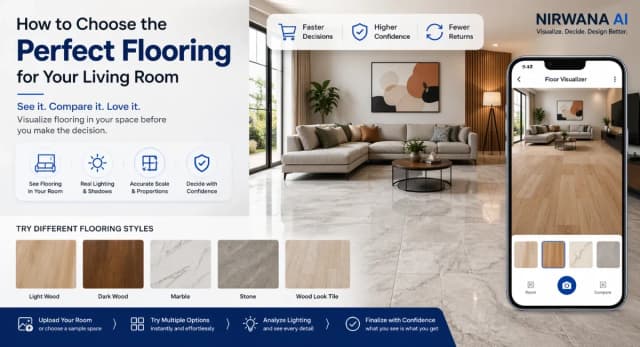
Step 1: Upload or Select a Room
Instead of imagining, the user uploads a real photo of their living room or selects a similar preset.
This is the starting point of accurate visualization.
Step 2: Try Different Flooring Options
Using a tile floor preview tool, they can instantly apply different flooring styles:
Light vs dark tones
Matte vs glossy finishes
Wood vs stone patterns
They can literally see flooring in their room in seconds.
Step 3: Analyze Lighting and Texture
Lighting plays a massive role in flooring perception.
A good virtual flooring visualizer shows:
Natural light impact
Shadow variations
Reflection and gloss behavior
This helps avoid surprises after installation.
Step 4: Compare Multiple Designs
Users can compare multiple options side-by-side.
This is something traditional methods cannot offer easily.
Step 5: Finalize with Confidence
By the time a decision is made, it’s not a guess anymore—it’s a validated choice.
How Nirwana AI Solves This at a Deeper Level
Now let’s talk about where most tools fall short—and where Nirwana AI goes further.
Most visualizers today are basic overlays. They don’t handle realism properly.
Nirwana AI focuses on making the visualization as close to reality as possible.
Here’s how:
1. True-Scale Visualization
The flooring is applied with accurate proportions, not stretched or distorted.
2. Advanced Lighting Simulation
It adapts to the lighting conditions of the room, ensuring the preview feels natural.
3. Seamless Texture Mapping
Patterns align properly across the floor, avoiding unrealistic repetition.
4. High-Quality Rendering
The output looks premium—close to what the final installed flooring would look like.
5. Real-Time Interaction
Users can quickly switch between options without friction.
This isn’t just a floor visualizer—it’s a decision-making engine.
Key Features That Matter for Flooring Brands
If you’re a flooring brand, here’s what actually drives results:
Interactive Floor Application
Customers can apply flooring instantly using a flooring visualization tool.
Room-Based Previews
Instead of generic images, they visualize products in real spaces.
Multiple Design Testing
Encourages exploration, which increases engagement and conversion.
Downloadable Visual Outputs
Sales teams can share customized previews with clients.
Mobile-Friendly Experience
Users can try it directly from their phones—no friction.
Real Industry Use Cases
Let’s make this even more real.
1. Retail Flooring Brands
Customers visiting your website can use a virtual flooring visualizer to test products before visiting the showroom.
Result:
Higher-quality leads
More informed buyers
2. Showroom Sales Teams
Instead of explaining flooring verbally, sales teams can show real previews instantly.
Result:
Faster decision-making
Better customer experience
3. E-commerce Flooring Stores
Customers can visualize flooring online without physical samples.
Result:
Increased conversion rates
Reduced return rates
4. Distributors & Dealers
Even if you don’t sell directly, your channel partners can use visualization to sell better.
Result:
Stronger dealer network performance
Better product positioning
The Competitive Advantage You Can’t Ignore
Here’s the reality:
Brands that adopt visualization early gain an edge.
Why?
Because they:
Reduce friction in the buying journey
Improve customer experience
Enable faster decisions
Stand out from competitors
While others are still relying on catalogs and samples, you’re offering a real, interactive experience.
Final Thoughts
Giving the ideal flooring to a living room is no longer a matter of hit and miss.
Having a floor visualizer, and a strong flooring visualization tool, customers will be able to visualize exactly how their options will appear during the making of a decision.
This turns the whole purchasing experience- confusion to clarity.
And in the case of brands, it is not only about visualization, but also the conversion, confidence and competitive advantage.
CTA
Would you like your customers to cease their guesses and make a confident decision? It is high time to improve the way you sell flooring.
Allow Nirvana AI to assist you in providing a really interactive, lifelike experience where customers can view flooring in their room prior to committing.
Because the brands that help customers see better… sell faster.