Curtain Visualizer Online: Why Curtain Brands Are Adopting AI to Increase Sales
4 Min Read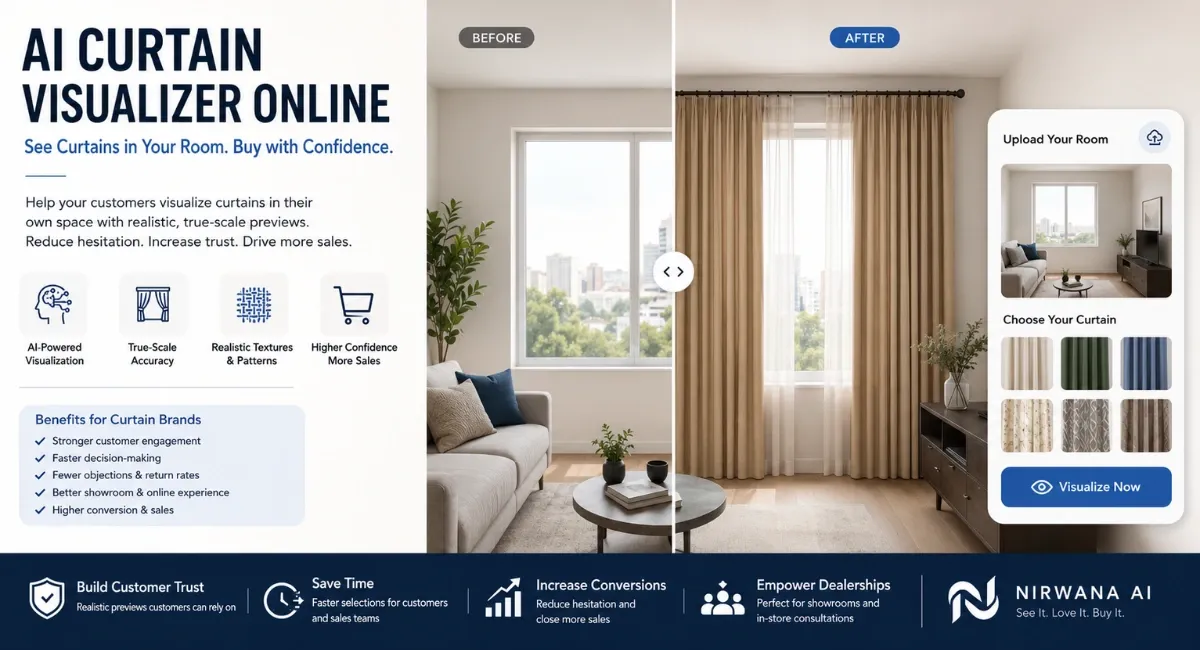
June 4, 2026
Talk to a curtain retailer, manufacturer, or dealer today and you'll get the same challenge over and over.
Customers love the fabric.
They like the colour.
They approve the design.
But they still hesitate to place the order.
The reason is simple.
They don't have a clear picture of what the curtain will look like in their room.
For years, the curtain industry has been based on fabric swatches, showrooms, catalogues, and sample books to aid customers in decision making. These techniques are still useful, but they tend to leave loopholes in the transactions for the buyer to fill.
Will my room appear darker in colour?
Does the pattern appear to be too busy when installed?
Will the fabric coordinate with my furnishings?
Will these curtains help to make my room smaller?
These doubts delay purchasing decisions, and lead to unnecessary delays in the sales process.
That is why, there is a growing need for a curtain visualizer online in the entire curtain industry.
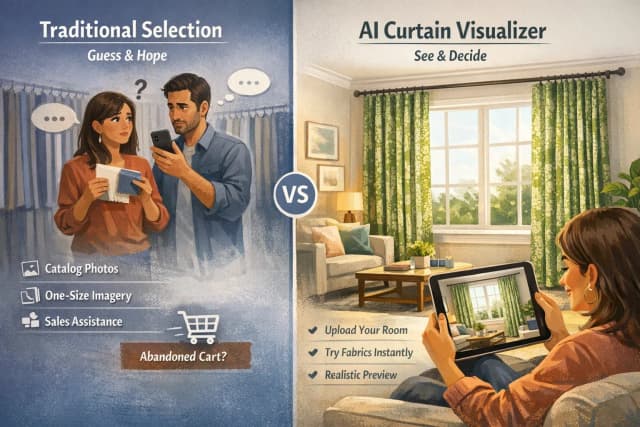
Instead of asking customers to imagine the final result, brands can now show it.
The Challenge Every Curtain Brand Faces
Curtains are very sensitive to their environment unlike many home furnishing products.
All the above differences in wall colors, furniture styles, room size, window size and natural lighting can make all the difference in the world between the way the fabric looks in a room.
This poses a special problem for curtain manufacturers.
A customer might fall in love with a curtain fabric whilst checking out online but not be sure while purchasing.
Many sales teams dedicate hours in answering questions, sending more pictures, arranging fabric samples, and having follow up calls just to get customers to feel more at ease and ready to make a purchase.
When brands have hundreds or thousands of curtain SKUs, this is an even larger challenge.
The more pages there are in the catalogue, the more difficult it will be for your customers to see what the outcome will look like.
How Curtain Buying Has Changed
Nowadays, customers want to interact with the shopping experience.
Before making a purchase, they want to see products in context.
Such behavior has already become the norm in the furniture, fashion, eyewear and cosmetics industries. The curtain industry is on the verge of a similar transition.
Customers no longer want to rely solely on product photography.
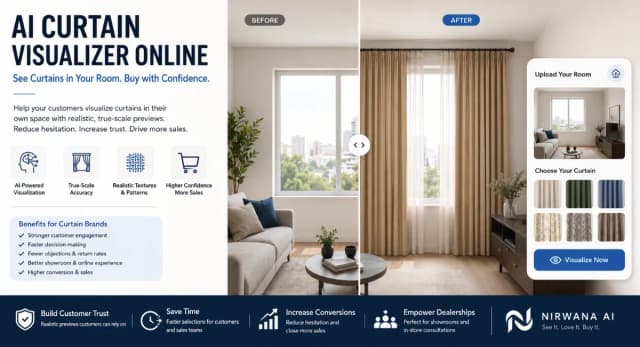
They want to upload a room image and instantly understand how a curtain will look inside their own home.
Brands that provide this experience often create stronger engagement, longer website sessions, and faster decision-making.
More importantly, they reduce uncertainty.
And uncertainty is one of the biggest reasons customers delay purchases.
Why Traditional Product Images Are No Longer Enough
Most curtain websites still rely on product photography.
But the issue is, product photography doesn't do it for you.
There will be a photo of the curtain which is close up on the fabric that will not show how it will hang from the ceiling down.
A studio photograph will not capture the light in your home's living room.
A catalogue picture simply can't show you how a patterned curtain will look when hung on a big window.
As a result, customers are forced to imagine the final outcome themselves.
Unfortunately, imagination is often where sales get lost.
How an AI Curtain Visualizer Solves This Problem
An ai curtain visualizer bridges the gap between product selection and purchase confidence.
Instead of browsing fabric samples in isolation, customers can see curtain designs applied directly to room images.
This creates a much clearer understanding of the finished result.
When customers can visualize the outcome, decision-making becomes easier.
Sales conversations become shorter.
Confidence increases.
Purchase hesitation decreases.
For brands, this translates into a smoother buying journey and stronger conversion rates.
How Nirwana AI Helps Curtain Brands
At Nirwana AI we have created a curtain visualizer for brands looking to modernize how they sell curtains online and in-store.
The goal is simple.
Educate customers on what they are purchasing before ordering.
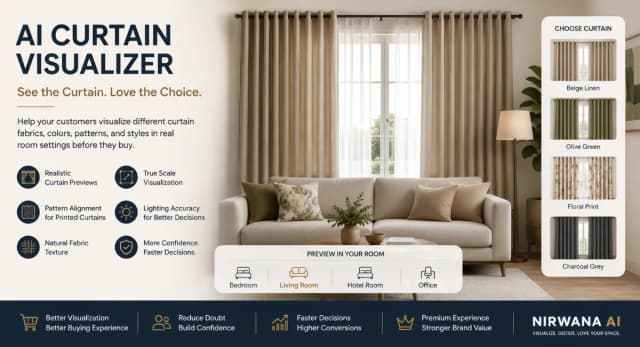
Customers or sales staff can upload room images and automatically add curtain collections to the photos.
They are able to see and compare the colors, patterns, textures and fabric choices in a realistic setting in just seconds.
Do not have to imagine, can make decisions according to what they see.
Realistic Previews That Customers Trust
The number one problem with visualization tools is unrealistic output.
When the curtain appears artificial, stretched or misplaced, customers lose their trust in it.
Realism is a key aspect of Nirwana AI.
The curtain's size is proportionate and harmonious to the room.
It's not a digital mock but rather a representation of the actual product that has been made.
It will give the customers extra confidence in the products they are looking at..
Trust is crucial in the high consideration purchase.
True-Scale Visualization Matters
The one of the most missed things in curtain selling is the scale.
What looks great on a swatch might look out of scale on a large window.
A dark fabric may look sophisticated in a showroom but overpower a compact room.
Nirwana AI helps solve this through true-scale visualization.
Customers can understand how curtain designs will appear relative to their actual room dimensions, making it easier to select the right product.
Pattern Alignment and Texture Accuracy
Many high quality curtain collections feature intricate patterns, woven fabrics, stripes, florals, and designer fabrics.
These details are crucial in making a purchase.
Nirwana AI uses automated texture mapping and pattern alignment technology to ensure curtain designs appear naturally across the visualized surface.
This allows customers to have a much greater idea of how their finished installation will look.
For those high-end curtain manufacturers and brands, this level of accuracy can build customer trust.
Supporting Dealers and Showrooms
The benefits of a curtain visualizer extend beyond e-commerce.
Dealers and showroom teams can use the platform during customer consultations.
Instead of carrying hundreds of fabric books and samples, sales teams can show realistic visualizations on a screen within seconds.
This creates a more engaging sales experience while helping customers narrow down options faster.
For brands with large dealer networks, this can become a powerful sales-enablement tool.
A Better Way to Manage Large Product Catalogues
Many curtain manufacturers manage extensive product portfolios.
Displaying thousands of fabrics effectively is not easy.
A curtain visualizer allows brands to display a greater number of products while not overwhelming the customer.
Users no longer have to scroll through numerous pages of products, but can simply compare the necessary products within their own room.
This makes large catalogues easier to navigate and easier to sell.
The Future of Curtain Sales Is Visual
The curtain industry is becoming increasingly digital.
Customers want more confidence before purchasing.
Sales teams want faster conversions.
Brands want better engagement and fewer objections.
A curtain visualizer online helps solve all three challenges.
Instead of relying on guesswork, brands can provide clarity.
Instead of asking customers to imagine the result, they can show it.
That shift alone can transform the buying experience.
For curtain manufacturers, retailers, dealers, and e-commerce brands looking to improve customer confidence and create a more modern sales process, Nirwana AI provides a practical and scalable solution.
The brands that adopt visualization today are not simply adding another website feature.
They are creating a better way for customers to buy.