AI Curtain Visualizer vs. Traditional Selection: Which Works Better for Modern Homes?
4 Min Read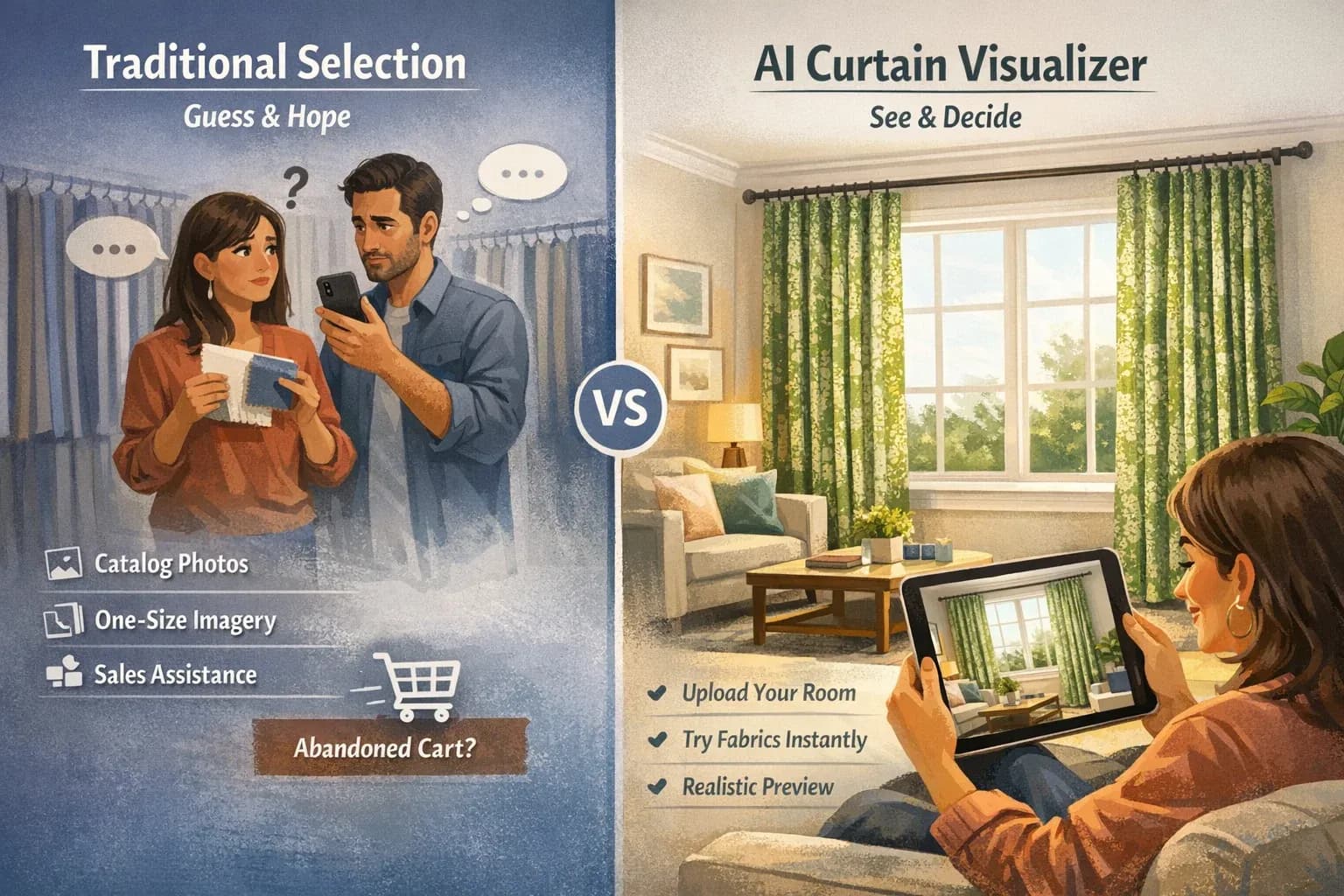
March 24, 2026
Walk into any curtain showroom on a Saturday and you’ll see the same scene: couples holding fabric swatches against photos on their phones, trying to imagine how a pattern will look in real daylight, on their actual windows. Half of them leave undecided, the other half leave slightly nervous about an expensive guess. That uncertainty is exactly what the modern AI curtain visualizer is trying to remove from the buying journey.
For Shopify merchants selling curtains or custom window treatments, this is no longer a “nice to have” experiment. It’s a strategic decision: do you keep relying on catalog photos and size charts, or do you bring a curtain visualizer online and let customers see their space transformed in a few seconds?
The Core Problem With Traditional Curtain Selection
Traditional selection works fine in theory: display beautiful product photos, add measurements, maybe include a style guide. In practice, it breaks down at the exact moment the buyer asks, “But will this actually work in my living room?” That’s where carts get abandoned and quotes go silent.
I’ve heard the same line from home décor merchants for years: “Our customers love our fabrics, but they can’t commit.” They’re not confused about your product; they’re unsure about the outcome. A beige curtain on a white studio wall tells them nothing about their north-facing home office with a dark floor and a low ceiling.
That gap between imagination and reality is where returns, exchanges, and lost sales live. And for Shopify brands, those frictions show up as higher support load, lower conversion, and a lot of manual hand-holding during what should be a self-serve experience.
AI Curtain Visualizer vs Traditional Selection: What Actually Changes?
1. From Guesswork to Concrete Visual Proof
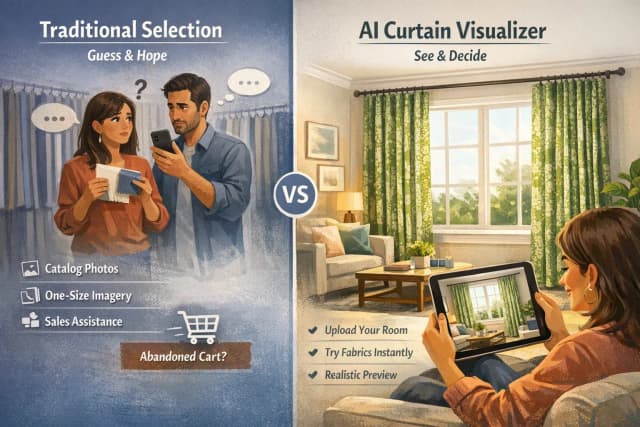
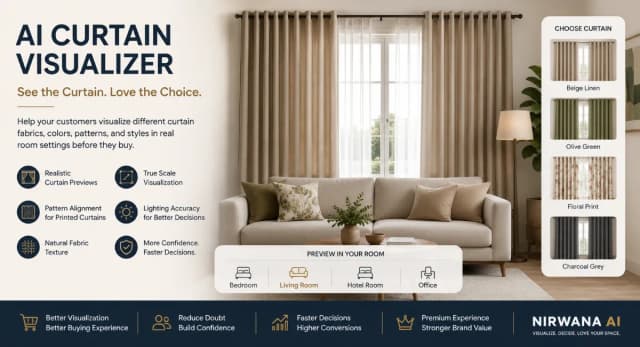
With a modern curtain visualizer, the buyer uploads a photo or uses a prebuilt room scene, chooses a fabric, and watches the curtain render in place. The psychological shift is subtle but powerful: they’re no longer buying “curtains” — they’re buying a specific look they can already see.
Compare that to static catalog browsing. You can stack unlimited product photos, but they’re still generic rooms that don’t match the buyer’s own lighting, window size, or furniture. AI doesn’t just make it prettier; it changes the decision from abstract to concrete, and that shortens the path to checkout.
2. From One-Size Imagery to Personalized Context
Traditional selection assumes the customer will mentally translate a styled shoot into their own context. Some can. Most won’t bother. A good curtain visualizer online flips that: it starts with their context and layers your product on top.
When we’ve implemented this for merchants, two patterns show up fast:
- Customers explore more SKUs because there’s no risk in trying
- Higher-ticket options get more attention once seen “in” the room
The outcome is not just more engagement; it’s more confident selection. And confident buyers complain less and return less.
3. From Sales-Driven Guidance to Self-Serve Discovery
In the traditional model, a lot of nuance lives in the salesperson’s head: which fabrics drape better on tall windows, which colours flatten in low light, which patterns overwhelm a small room. Online, that nuance often disappears into a generic FAQ.
An AI curtain visualizer quietly encodes a lot of that guidance. When a customer sees that a bold pattern dominates their tiny guest room, they adjust. When a sheer fabric looks washed out in a bright, south-facing space, they try something heavier. You’re still influencing the decision, but without forcing the buyer into a chat or phone call.
4. From Static Storefront to Living Product Experience
Most Shopify curtain stores still operate like digitised catalogues. Pages load, users scroll, maybe zoom, then bounce. When you add a visualizer, the store starts behaving more like a design studio session.
The effect on metrics is usually straightforward: longer session times, more interactions per visit, and a higher percentage of visitors reaching the “I know what I want” stage. You’re not just merchandising products; you’re hosting a low-friction design experience inside your storefront.
Business Impact & Adoption for Shopify Curtain Brands
So is an AI curtain visualizer always better than traditional selection? Not automatically. It’s better where the stakes of getting it wrong are high — custom sizes, premium fabrics, made-to-order production, or markets where returns are expensive or hard to resell.
For those businesses, three impacts tend to matter most.
Higher Conversion on High-Intent Traffic
If you’re already paying for qualified traffic, every abandoned cart hurts. Visualizers tend to lift conversion not by creating demand from thin air, but by converting the “almost there” buyer who just needs to see it once. That’s especially true for mobile shoppers, where scrolling through 40 fabric thumbnails is painful, but tapping through 5–6 visualized options feels natural.
Fewer Support Tickets and “Is This Right for My Window?” Questions
Support teams for curtain brands spend a lot of time answering the same scenario-based questions. Once customers can experiment visually, many of those questions disappear. The team can focus on edge cases and trade customers, not basic reassurance.
It also creates better-qualified conversations. When a buyer reaches out after using a curtain visualizer online, they usually have a specific configuration in mind. That shortens sales cycles and reduces back-and-forth.
Healthier Margins Through Reduced Returns
Returns in custom or made-to-measure curtains are brutal. You can’t always resell, and even when you can, it’s at a discount. Visual confirmation upfront is one of the few levers that actually moves return rates in this category.
Merchants who track this seriously often see a slow but steady improvement over a few months, not an overnight miracle. As more customers buy through the visualizer flow instead of the old “add to cart and hope” flow, the mix shifts toward better-fit orders.
Closing Perspective: Choosing the Right Approach for Your Brand
Traditional selection isn’t dead; it’s just incomplete on its own. For low-cost, off-the-shelf curtains, a clean catalog might still be enough. But if your Shopify brand leans into customisation, premium positioning, or design-conscious homeowners, relying only on static photos is a strategic blind spot.
The question isn’t “AI curtain visualizer or traditional method?” It’s how you combine them so the visualizer handles doubt, and your content and merchandising handle desire. When those pieces line up, customers stop asking, “Will this work?” and start saying, “This is exactly what I was looking for.”
If you’re at the stage where every marginal gain in conversion and reduction in returns matters, it’s probably time to treat visualization not as a gimmick, but as core infrastructure for how modern homes get furnished online.