How to Compare Two Marble Slabs Before Choosing the Right One
4 Min Read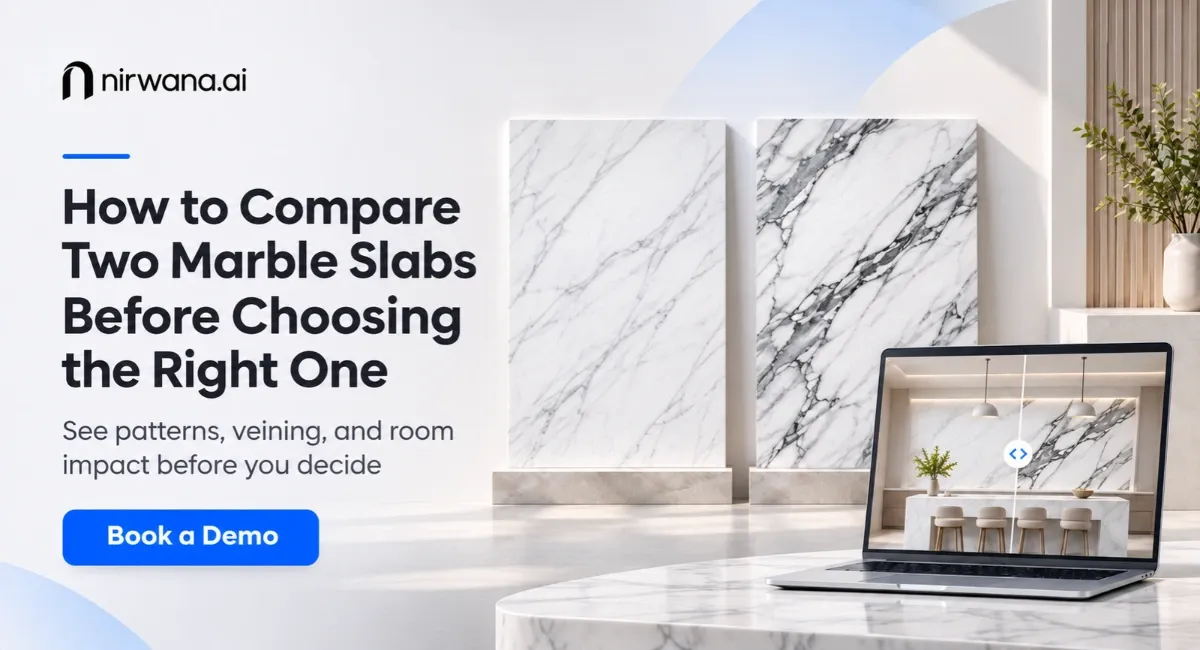
November 16, 2026
Suppose you are in a marble show room and see two beautiful slabs of marble.
One such eye is soft gray with white stripes. The other one is bold and dramatic in terms of patterns and it immediately catches your eye.
Both look stunning.
However, which one will appeal to you in your home?
That's where selecting marble gets challenging. It is not just a choice of stone. You're about to make a choice on the design of a significant portion of your home for years.
After buying, cutting and installing your marble, you're not going to be able to go back and change your mind without paying for that change!
Therefore, before you choose the best marble slab, let's learn how to compare the two slabs of marbles properly.
Two Slabs Can Feel Completely Different While Being The Same.
Here is something that many buyers don't know.
The patterns on two slabs of the same type of marble may be quite distinct.
This is because marble is a natural substance. The natural development of its veins, colour variations and mineral markings result in each slab being unique.
Now think of comparing two slabs of Calacatta marble.
One is light in colour with light grey veins in between, the other is thick in colour with thick veins all over its surface.
Both look equally impressive in the showroom.
The second slab could have a significant impact on a large living room wall, though.
Just look at the names of marbles, don't compare! Research the real slabs that you are considering.
Look at the whole surface whenever possible, don't just look at samples or catalogue photos.
Pay attention to the Veins, not the Colour
Most people initially look at the back color of the marble when selecting marble.
A white, beige, grey or cream color.
But veining can have a more significant effect on the final look.
Consider a kitchen counter top.
A marble slab with hints of veining can create a sense of tranquility and harmony. A large square may be the kitchen's focal point if it also has big diagonal veining.
Either of these is not necessarily better.
That will be based on the room and the look you are aiming for.
Note the thickness of the veins, their direction and the number of changes in the pattern.
Also take into account the location of those veins when you cut.
A beautiful pattern near the edge of the slab may be lost during the manufacturing process.
This is the reason it is more important to compare the whole slab rather than one great-looking piece.
Does the Marble Look the Same in the Lighting within your Room?
Ever thought about how shiny marble is in the showroom versus at home?
Part of that difference can be attributed to lighting.
In showrooms, illumination is bright and is used to accentuate the stone's texture and natural patterns.
Your house could be more subdued in light, warmer in artificial light, or shaded all day.
The cool white marble might seem a little warmer in yellow lighting. Likewise, darker veins may stand out relative to the light.
The finish is important, too.
Polished marble reflects more light, whereas honed marble will typically result in a more subdued look.
To make a decision, try to compare both slabs under the same lights and then look at the actual finishes.
How much of the marble will be visible in your room?
This is an important question that is often forgotten.
Do you want to use marble for a small countertop or as a whole feature wall?
The impression which the same slab can make varies greatly according to its surface area.
A large kitchen island may be perfect to showcase a dramatic marble pattern, for instance.
However, if you are intent on using the same dramatic veins throughout a wall, you may end up with a rather picture-full room.
Although judging by the showroom display is one of the most important things to do, think about how much of the pattern will actually show after installation.
This is where a visual comparison can really be helpful.
Watch Both Marble Slabs in Your Real World!
In the past, buyers would have to visualize how a marble slab would look when installed.
Today, a marble slab visualizer can facilitate that.
Nirwana AI allows you to upload a picture of a room and try out certain marble designs on the floor, wall or countertop.
Automated surface detection, scale-aware texture mapping, vein alignment, and realistic lighting effects generate room previews via its AI-powered visualization.
Suppose you're picking between two marble slabs to put on the wall in your living room.
You can use the same room photograph as a preview of each design, rather than it being solely imaginative.
This will help you see which pattern will fit your space without needing to install the pattern or the stencil.
A virtual marble slab viewer is also available to help view the various patterns and book matched arrangements prior to selecting an option to decide.
However, a digital preview can not guarantee the same colour reproduction or cutting arrangement as the final product. Confirm slab and fabrication layout always separately.
Why it's easier for Marble Showrooms to make comparisons.
Let's say that a customer comes to your marble showroom with 2 pieces of marble that he wants to purchase.
Both of these are liked by them but they can't choose what they like in their home.
Technically, a salesperson can describe the colour, finish and veining differences, but the customer might not be able to envision what the finished product will look like.
Now, if you were to bring both of these to the customer's room, how would you do it?
The conversation turns to more practical matters.
The customer can not only decide which slab looks better, but can also consult how each design will look inside the room, based on its size, lighting, and decor.
That's where the power of Nirwana AI comes into play for marble brands and retailers to build a more useful shopping journey.
Customers receive a visual context and sales staff can provide answers based on better pictures.
The Right Marble Isn't Always the Most Dramatic One
If comparing two marble slabs, do not rush towards the first slab that you see.
Consider veining, colour uniformity, finish and the amount of slab to be seen in your space.
The most important thing to try to do is to grasp how each option will appear in your actual room.
The best marble slab isn't just the one that is prettily designed in a showroom. This is the one that fits in your space.
Looking to assist customers to compare marble designs before making a final decision?
Visit Nirwana AI's Marble Slab Visualizer and learn how to make marble selection easier with realistic visualizations.