Why Quartz Looks Different in Showroom and Home Lighting
4 Min Read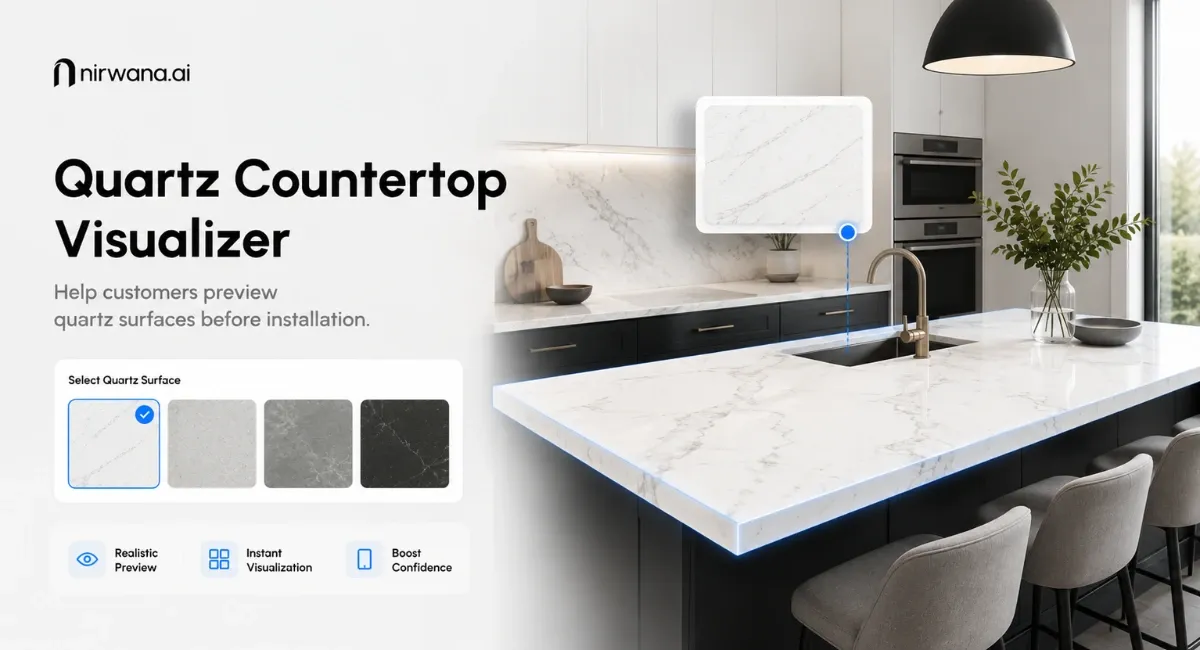
August 17, 2026
At first, you might think that selecting quartz is a simple process. A customer walks into a showroom, looks at an attractive slab or a small sample and says to himself, “This is the one.”
After that, it's down to the real kitchen.
Then, the quartz can appear warmer or cooler, darker or lighter, busier or busier than it is expected to be.
One of the most frequent issues when purchasing countertops is this. It's not always the quartz problem. What's the issue? Customers are about to make an important design choice under an environment that's quite distinct from their own homes.
A quartz countertop visualizer can make all the difference in the purchasing experience.
Why Quartz Looks Different Outside the Showroom
Showrooms are meant to showcase materials in an appealing manner. They typically rely on ‘controlled lighting', large overhead lighting, open spaces, and display selection.
There could be a great deal of difference in a customer's kitchen.
White quartz can look brighter in the day under natural light and warmer on an evening under artificial lighting. Grey veining is not so noticeable in the showroom but appears much more prominent when paired with white cabinets.
The area of the surrounding materials also influences perception.
The same quartz countertop may appear totally different when it's next to:
Warm wooden cabinets
Matte white cabinetry
Dark grey cabinets
Stainless-steel appliances
Warm or cool backsplash tiles
Customers are therefore not really choosing quartz alone. They are choosing how that quartz will interact with their entire kitchen.
The Small Sample Problem
Another challenge is scale.
Many buyers select quartz using a small sample. But a 10-inch sample cannot properly communicate how veins and patterns will appear across a large island or several metres of countertop.
A subtle vein visible on a sample might repeat heavily across the final installation. A bold pattern may look attractive in isolation but feel overwhelming when applied to a full kitchen.
This is exactly why brands are beginning to use a countertop visualizer during the sales process.
Instead of asking customers to imagine the final result, brands can actually show it.
How Buying Behaviour Is Changing
Today’s buyers are much more visual.
Before making an expensive countertop purchase, they want to compare options, test combinations, and understand what the final kitchen could look like.
They are already used to previewing products digitally in other industries. Countertop buying is moving in the same direction.
No customer should be forced to rely on imagination, showroom or a small physical sample.
They will use a quartz countertop visualizer to display an image of their own kitchen, so they can see different quartz options within their own home.
That creates a much more confident buying experience.
How Nirwana AI Helps Quartz Brands
Nirwana AI allows quartz brands, manufacturers, distributors, and retailers to turn their product catalog into an interactive visualization experience.
The process is simple.
A customer uploads a kitchen image or selects a sample room. Nirwana AI identifies the countertop area and automatically maps the selected quartz texture onto the surface.
The technology focuses on maintaining the room's original structure while generating a realistic preview.
This means customers can understand how the product may look with their actual cabinets, backsplash, lighting, and kitchen layout.
True-Scale Visualization
Scale is extremely important for quartz.
If the product texture is displayed too large or too small, the customer receives an unrealistic impression of the stone.
Nirwana AI uses true-scale visualization so that patterns and veins appear more naturally according to the actual dimensions of the countertop.
Pattern Alignment
Quartz designs with strong veining need careful visual placement.
Nirwana AI supports pattern positioning and alignment, allowing the surface pattern to be adjusted across countertop areas.
For waterfall islands and larger surfaces, this can help customers better understand how the design may flow across different sections.
Lighting Accuracy
One of the biggest reasons quartz looks different after installation is lighting.
The visualization should not just be a flat texture that is pasted over the countertop, but rather take into account the existing environment.
Nirwana AI preserves the natural shadows, highlights and lighting around the quartz, giving customers a more realistic view on how it could look in their space.
Automated Texture Mapping
Manual rendering can be time consuming.
Automated texture mapping enables brands to link their quartz catalogue to the visualiser and enable customers to jump from one product to the other in a matter of seconds.
A customer might have been able to order a soft-veined white quartz, a dramatic Calacatta look and a warmer cream surface all in one kitchen in a few clicks.
Where Quartz Brands Can Use It
A quartz countertop visualizer can be beneficial for a number of aspects of the sales process.
On a brand's website, it can help users transition from product browsing to envisioning the product in their own kitchens.
A showroom can utilize it to speak with customers in lieu of physical samples, when discussing options.
Distributors and dealers could also offer the experience virtually, enabling customers to narrow down their picks before seeking samples or attending the store.
With a high volume of products, it can make finding products much more interactive.
From Guessing to Confident Decision-Making
The customers have an understanding that changing the quartz looks and costs them a lot in the future.
Quartz brands have the greatest opportunity not just in providing more designs, but in providing more great designs. It helps buyers be confident with the design that they select.
A countertop visualizer will connect between the showroom sample and the actual kitchen.
The customer can view how the colors, veins, scale, patterns, and lighting all function together before deciding upon which one to purchase.
This can lead to a better digital customer journey and enhance product engagement while building confidence in purchase decisions for quartz brands.
To make your quartz catalog come to life before customers make a purchase, Nirwana AI can help you visualize your items with the power of AI.