Why Carpet Buying Needed a Smarter Approach
4 Min Read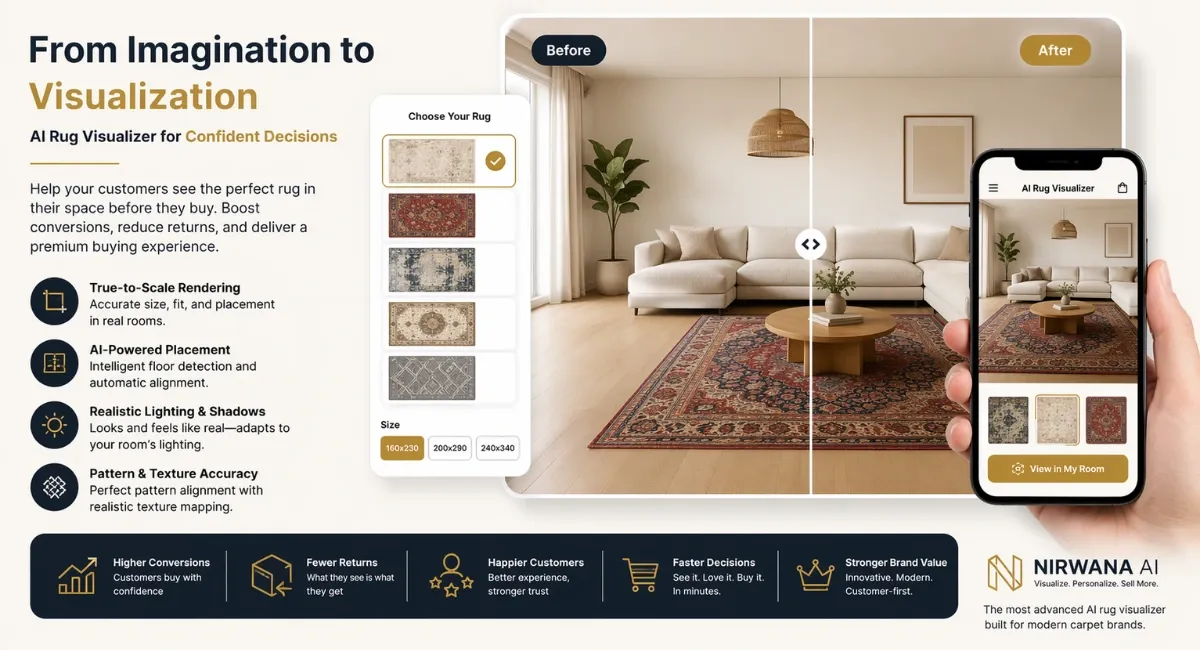
April 17, 2026
When you ever sell carpets or rugs you already know the hardest part of it is not the product, it is assisting the customer to visualize it in their home.
I have observed this in brands, showrooms, and online stores: a customer is in love with a rug design, loves the feel, may even agree on the quality, but is hesitant at the point of purchase. Why? They are unable to imagine how that carpet will really be in their living room, bedroom or office.
This is exactly where a carpet visualizer changes the game.
Today, with an advanced AI rug visualizer or rug visualizer, brands can show their products inside real spaces instantly. And not just generic mockups—but accurate, realistic, and true-to-scale previews that eliminate guesswork completely.
At Nirwana AI, we’ve seen how this shift is fundamentally changing how carpets are sold—and more importantly, how quickly they are sold.
The Core Challenge in Carpet Sales
Let’s break down the real-world problems carpet brands face:
1. Customers Can’t Visualize Scale and Fit
A rug might look perfect in a catalog, but customers constantly struggle with:
“Will this be too big?”
“Will it look small in my room?”
“Will it align properly with my furniture?”
Without a rug visualizer, these questions create hesitation—and hesitation kills conversions.
2. Pattern Confusion and Misalignment
Carpets are highly pattern-driven products:
Geometric
Traditional
Abstract
Minimal
But static images don’t show how patterns will align within a room layout. This often leads to:
Wrong purchases
Returns
Customer dissatisfaction
3. Lighting and Color Misinterpretation
A rug can look completely different depending on:
Natural vs artificial light
Warm vs cool tones
Floor contrast
Without accurate previews, customers feel uncertain about color decisions.
4. High Dependence on Sales Teams
In offline stores, customers rely heavily on:
Sales staff explanations
Physical samples
Guess-based decisions
This slows down the buying process and limits scalability.
The Shift in Buying Behavior: From Imagination to Visualization
Today’s customer doesn’t want to imagine—they want to see.
We’re seeing a major shift:
Customers expect instant previews
They want personalization
They prefer interactive buying journeys
This is where a carpet visualizer becomes not just a feature—but a necessity.
Instead of browsing static catalogs, customers now:
Upload their room images
Select a rug
See it placed instantly in their space
This single interaction reduces decision time dramatically.
For brands, this means:
Faster conversions
Lower returns
Higher customer satisfaction
The AI Advantage: What Makes a Modern Rug Visualizer Powerful
Not all visualization tools are equal. A basic overlay won’t solve real problems.
An advanced AI rug visualizer goes deeper.
1. True-Scale Visualization
We ensure that the carpet fits proportionally within the room.
No unrealistic stretching. No distortion.
Customers see:
Actual size representation
Real placement relative to furniture
2. Intelligent Surface Detection
The AI understands where the carpet should be placed:
Floor boundaries
Room perspective
Object positioning
This allows natural placement—no manual adjustments needed.
3. Pattern Alignment Accuracy
This is critical for carpets.
With Nirwana AI:
Patterns are mapped correctly
Orientation is preserved
Repetition looks natural
This removes one of the biggest visual inconsistencies seen in basic tools.
4. Lighting and Shadow Matching
We simulate real-world lighting conditions:
Shadows fall correctly
Colors adapt to the room tone
Textures appear realistic
This creates a “this looks real” moment for customers.
5. Automated Texture Mapping
Carpet textures—whether plush, woven, or flat—are applied with depth and realism.
Customers can actually feel the product visually.
How Nirwana AI’s Carpet Visualizer Works
Let me simplify how brands typically use our carpet visualizer:
Step 1: Upload Carpet Catalog
Brands upload:
Product images
Variants (colors, patterns, sizes)
Step 2: Customer Uploads Room Image
The end user uploads their room photo—or selects from preset rooms.
Step 3: AI Places the Rug Automatically
The system:
Detects floor areas
Places the rug correctly
Maintains scale and perspective
Step 4: Instant Realistic Preview
Within seconds, the customer sees:
Their selected rug
In their own room
With realistic lighting and placement
Step 5: Explore Variations
Customers can:
Switch designs
Change sizes
Compare options
All without leaving the page.
This is where decision-making becomes effortless.
Features and Benefits for Carpet Brands
1. Faster Purchase Decisions
When customers can see the product clearly, they decide faster.
2. Increased Conversion Rates
Visualization removes uncertainty—leading to higher sales.
3. Reduced Returns
Customers know exactly what they’re getting.
4. Stronger Brand Positioning
Offering an AI rug visualizer instantly positions your brand as:
Innovative
Customer-centric
Premium
5. Scalable Sales Enablement
Instead of relying on physical stores:
Your website becomes your best salesperson
Your catalog becomes interactive
Real Industry Use Cases
1. E-commerce Carpet Brands
Online brands struggle the most with visualization.
With a rug visualizer, they can:
Replace static product pages
Offer interactive previews
Increase checkout rates
Example:
A carpet e-commerce brand integrates Nirwana AI. Customers start visualizing rugs in their homes. Conversion rates jump because customers feel confident before purchasing.
2. Retail Showrooms
Even in physical stores, visualization adds value.
Customers can:
Scan a QR
Upload their room
Test multiple rugs instantly
This reduces dependency on physical samples.
3. Interior Designers
Designers can present options to clients quickly.
Instead of explaining:
They show
This improves:
Client approval speed
Decision clarity
4. Manufacturers and Distributors
Even if they don’t sell directly to customers, they empower their network.
Dealers and retailers can:
Use the AI rug visualizer
Close deals faster
Promote the brand better
Why This Matters Now More Than Ever
The carpet industry is becoming increasingly competitive.
Products alone are no longer enough.
The real differentiation lies in:
Experience
Speed
Confidence
A carpet visualizer directly impacts all three.
Brands that adopt this early:
Win customer trust
Build stronger dealer relationships
Close faster than competitors
Brands that don’t:
Lose customers at the decision stage
Conclusion: From Product to Experience
Carpets cannot be made under the impulse to purchase them, they are visual decisions.
When your customer is unable to see it, he or she will not buy it.
A powerful rug visualizer bridges this gap.
At Nirwana AI, we’re not just helping brands show carpets—we’re helping them create buying experiences that convert.
If you’re a carpet brand looking to:
Increase conversions
Reduce returns
Deliver a premium experience
The time to get rid of fixed catalogs.
Allow your customers to have a preview of what they are buying.
Get a demo with Nirwana AI and see the future of selling carpets.