Countertop Visualizer: See Your Dream Kitchen Before You Buy Any Stone Now
4 Min Read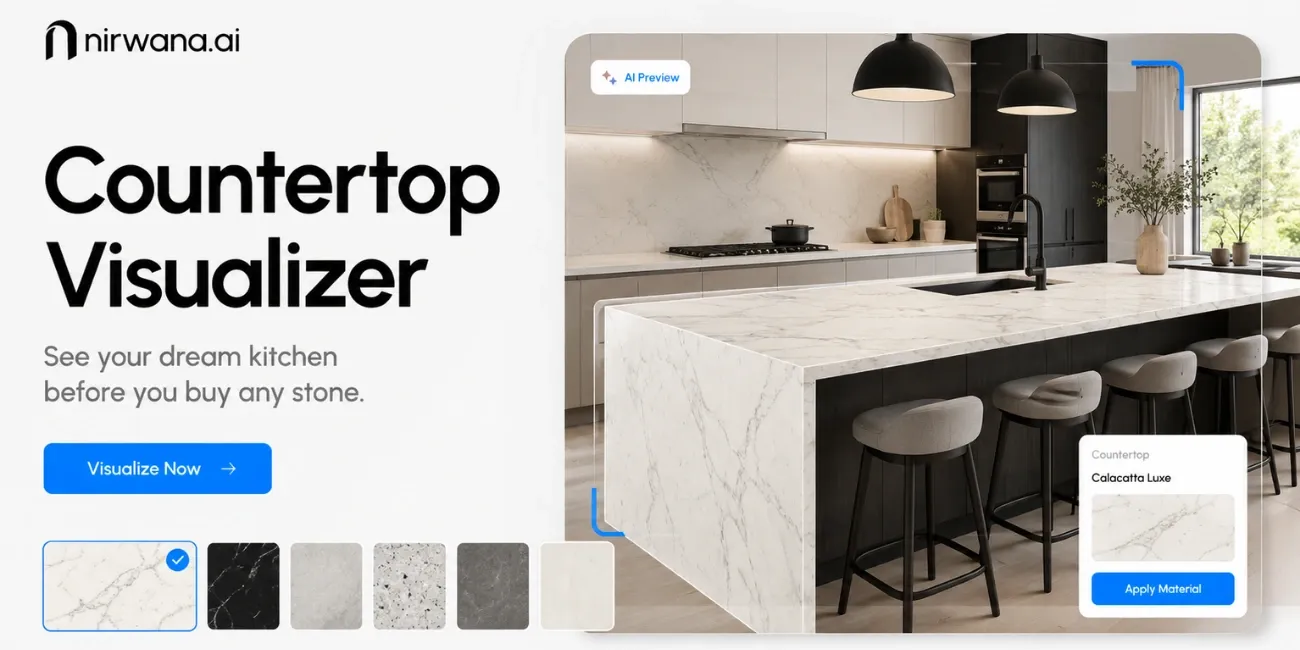
August 24, 2026
Choosing a countertop looks simple until the customer actually has to make the final decision.
A small stone sample may look beautiful in a showroom. A slab photo may look perfect on a website. But once the customer starts thinking about their own kitchen, the questions begin.
Will this stone work with my cabinets?
Will the veining look too busy across the island?
Will this shade appear darker under my kitchen lighting?
What will the waterfall edge actually look like?
This uncertainty has a significant impact on sales for countertop brands, fabricators, dealers and distributors. Customers can enjoy the products but not purchase them, since they can't confidently visualize the finished product.
This is exactly where a Countertop Visualizer changes the buying experience.
Why Countertop Buying Is Still Difficult
Countertops are not impulse purchases. Customers know that once the stone is cut and installed, changing it is expensive and inconvenient.
The challenge is that most customers are still expected to make this decision using small samples, catalogue images, showroom displays, or photos of installations in someone else's home.
None of these answers the most important question:
“How will this countertop look in my kitchen?”
The issue is magnified with surfaces like marble, granite, quartz, quartzite, and other patterns or natural veining.
A four-inch sample cannot show how a pattern will spread across a ten-foot kitchen island.
For brands, that creates hesitation. And hesitation directly affects conversion.
The Countertop Buying Journey Is Changing
Today's consumers are looking for more than just information about your product.
They would like to try the product first before purchasing.
Users already use images of kitchens, Pinterest boards, interior design apps, etc. to visualize various combinations, and now AI-powered tools can help them imagine even more. The behaviour tells us something important: customers are actively searching for visual confidence.
A dedicated Countertop Visualizer gives them that confidence without forcing them to mentally imagine the result.
Instead of asking a salesperson, “Do you think this will look good?”, the customer can actually see the countertop inside their own space.
That moves the conversation from uncertainty to selection.
How AI Visualization Helps Countertop Brands
AI visualization makes the shopping experience interactive.
Imagine a customer looking at three quartz options on a brand's website.
Typically, they would be able to open every product page, take screenshots, compare samples, go back to the showroom, but still not be sure.
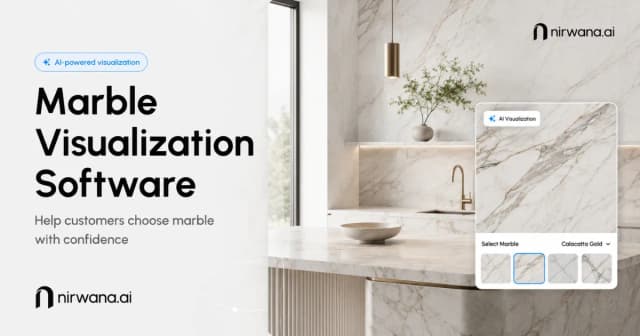
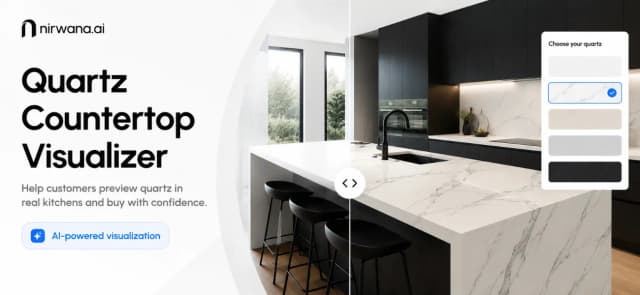
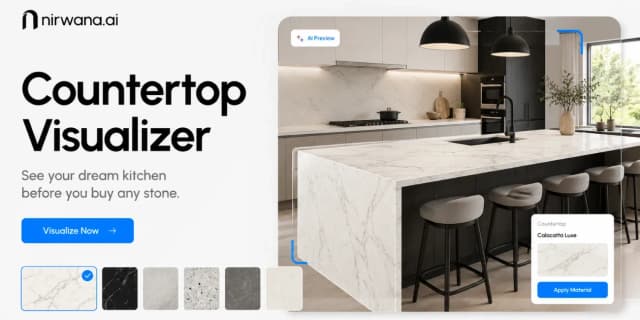
They can upload a picture of their kitchen, draw the area that is the countertop, and apply the products to each area digitally with a Countertop Visualizer.
In seconds they can see how a warm beige surface functions with wooden cabinets, versus how a white marble look countertop transforms the overall room.
That is a completely different buying experience.
The customer is no longer simply viewing a product.
They are viewing their kitchen with the product installed.
How Nirwana AI Works for Countertops
Nirwana AI helps countertop brands turn their digital catalogues into realistic visualization experiences.
A customer uploads their kitchen image and selects the countertop surface. The chosen product can then be realistically mapped onto that area while maintaining the surrounding kitchen.
The system focuses on details that matter specifically in countertop visualization.
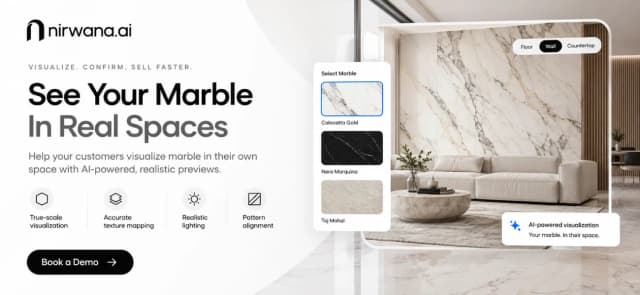
True-Scale Visualization
Large veins and patterns should not appear artificially stretched or compressed.
Nirwana AI can help maintain realistic product scale so customers get a better understanding of how the surface may appear across islands, counters, and other worktops.
Pattern and Vein Alignment
Pattern positioning is especially important for marble-look materials and natural stone.
For example, a customer may want to understand how a dramatic vein runs across the main counter or continues toward a waterfall edge.
Being able to visualize pattern direction and placement helps make the preview far more useful than simply placing a flat texture over the countertop.
Realistic Lighting
Stone appearance changes dramatically depending on light.
A warm white countertop can look different under yellow indoor lighting compared with daylight entering through a large kitchen window.
Nirwana AI creates previews while considering the original room environment, helping the visualization feel more natural and believable.
Automated Texture Mapping
Instead of manually creating individual renders for every product and kitchen combination, countertop textures can be mapped digitally onto detected surfaces.
For brands with hundreds or thousands of SKUs, this makes visualization much easier to scale.
What This Means for Countertop Brands
Consider a quartz manufacturer with 300 designs.
Traditionally, customers visiting its website might browse dozens of product images but shortlist only a few products because imagining every option is exhausting.
Now imagine adding a Countertop Visualizer beside the catalogue.
The customer finds a design they like, clicks “Visualize,” uploads their kitchen, and sees it directly on their countertop.
They test another option.
Then another.
Instead of leaving the website to think about the purchase, they continue engaging with the brand's products.
For dealers, the same experience can work inside showrooms. A salesperson can help customers compare shortlisted surfaces using the customer's own kitchen photo.
For fabricators, visualization can make discussions around pattern direction, countertop areas, and design preferences much clearer before the project progresses.
From Product Browsing to Purchase Confidence
The real value of a Countertop Visualizer is not simply that it looks impressive.
It removes uncertainty from a high-consideration purchase.
When customers can see products in context, compare alternatives, understand pattern movement, and experience the final look before installation, they can make decisions with greater confidence.
And for countertop brands, greater confidence can mean stronger product engagement, better-quality enquiries, shorter decision cycles, and more opportunities to convert interest into sales.
The countertop industry does not need another static catalogue.
It needs a better way for customers to experience products before they commit.
Nirwana AI enables brands to bring that experience directly to their website, showrooms, and their digital sales journey.
Perhaps your customers are still envisioning how your surfaces will enhance their kitchens; if so, it might be time to let customers see the surfaces for themselves.
Try out Nirwana AI's Countertop Visualizer and make confident purchases.