Small Sample, Big Risk: Avoid Costly Mistakes with a Quartz Visualizer
4 Min Read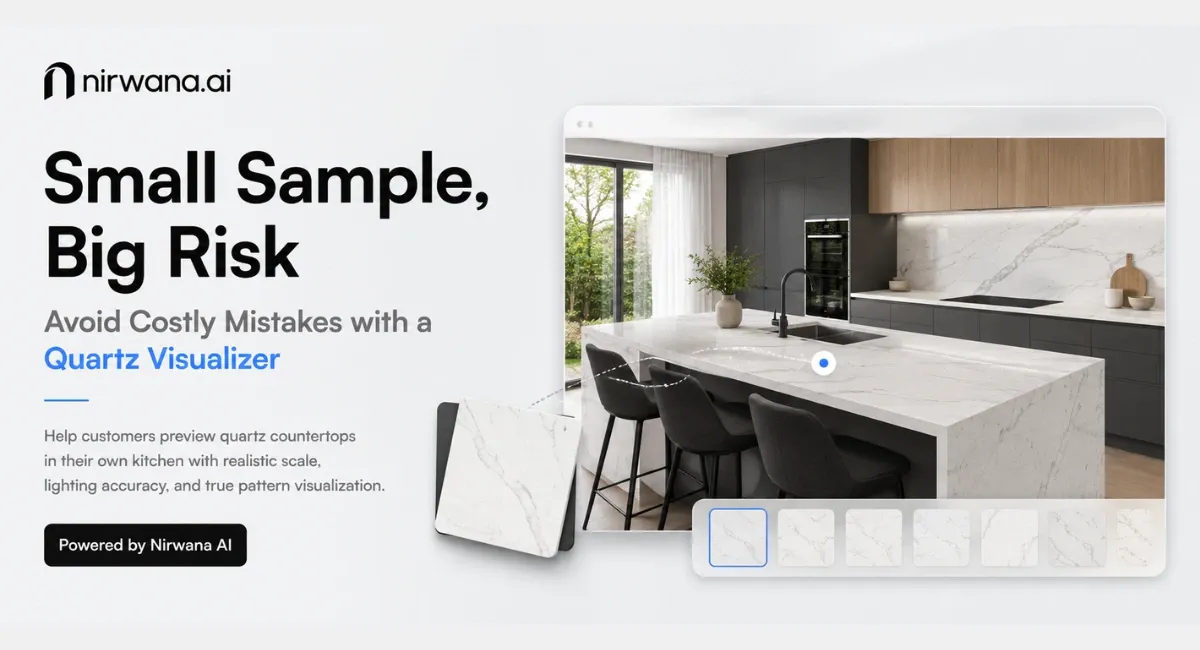
August 4, 2026
It might seem like it is very easy to decide which kind of countertop material to use for a kitchen. A customer goes to a showroom, looks at a few little samples, looks at different shades and chooses the one that suits the customer.
However, that is where the real issues begin.
A small sample of quartz will not give you an accurate representation of the whole design when it comes to a large kitchen countertop, island, backsplash or waterfall edge. It can be a perfect match in the showroom but completely different once installed in the customer's home. A subtle veining on a sample is sometimes more noticeable on a larger area.
This makes it confusing for customers. It causes longer sales cycles, multiple visits to the showroom, and increased dissatisfaction following installation for quartz brands, dealers and fabricators.
To eliminate this uncertainty, a quartz visualizer can help customers see how the quartz they are interested in will appear in their genuine environment before they buy it.
Why Small Quartz Samples Create Big Buying Risks
Quartz is a high value long-term investment item. After cutting, fabricating and installing the slab, it is costly and cumbersome to replace it.
But, a client is expected to make this permanent decision based on a sample just a few inches wide.
They struggle with questions such as:
Will this white quartz look yellow under warm lighting?
Will the veining compete with my kitchen cabinets?
Will the pattern look too busy across the island?
Should I use the same quartz on the backsplash?
Will the final installation look like the catalogue image?
These are not minor design concerns. They directly influence whether a customer feels confident enough to purchase.
When customers cannot imagine the final result, they delay decisions, compare more products, request additional samples, and ask multiple people for opinions. This increases friction throughout the buying journey.
How Quartz Buying Behaviour Is Changing
Today’s customers want more than a physical sample and a product brochure. They already have a habit of viewing products online before purchasing.
They want brands to get them a sense of what a product would look like in their personal settings.
This is particularly the case in quartz, as customers are not just buying a product. They're choosing a surface that needs to coordinate with the cabinets, flooring, wall colors, appliances, lighting and more within the kitchen.
A quartz visualizer turns this complicated decision into an easier visual experience. Instead of asking customers to imagine the result, brands can show it to them.
From a sales and marketing perspective, this reduces one of the biggest conversion barriers: uncertainty.
How AI Visualization Improves Quartz Selection
AI visualization enables customers to upload a photo of their kitchen and directly implement various quartz products on the countertop area.
They can see how each option interacts with the existing room, rather than a neutral showroom backdrop.
The strongest visualization experiences do more than place a flat colour over the surface. They maintain realistic lighting, pattern proportions, shadows, perspective, and material appearance.
This helps customers understand:
How warm or cool the quartz will appear
Whether the veining is subtle or prominent
How the pattern looks across a complete countertop
Whether the quartz complements the cabinets
How it appears on an island or backsplash
Which shortlisted design works best in the space
This gives customers a stronger reason to move forward with their purchase.
How Nirwana AI Works for Quartz Brands
Nirwana AI enables quartz brands, dealers, and fabricators to convert their real product catalogue into an interactive visualization experience.
Customers can upload their own room image or choose from preset kitchen spaces. They can then apply actual quartz products to countertops and other relevant surfaces.
Automated texture mapping helps place the quartz design accurately on the selected area. The system takes the shape and angle of the countertop into account and creates a natural and seamless look in the room.
A true scale analysis will prevent patterns and veins from looking stretched or compressed. For products that feature bold movement, marble-like designs, or large veins, it is especially crucial to pay attention to this detail.
Lighting accuracy also helps to maintain the natural appearance of the room, leading to a more realistic preview and facilitating decision-making.
Key Features and Benefits of a Quartz Visualizer
Realistic Product Previews
Customers can see actual quartz products in a realistic kitchen environment instead of depending only on samples or catalogue photographs.
True-Scale Pattern Visualization
Patterns and veins are shown in a realistic scale, allowing the customer to get an idea of how it could appear over a wider surface area.
Side-by-Side Product Comparison
Customers have the ability to easily alternate between their shortlisted quartz options and easily compare them all in the same room under the same lighting.
Countertop and Backsplash Visualization
Brands can help customers test whether they should use quartz only on the countertop or continue it onto the backsplash for a coordinated design.
Faster Purchase Decisions
When customers can clearly see the final look, they require fewer samples, fewer showroom visits, and less reassurance before confirming their choice.
Reduced Post-Purchase Regret
Having a better preview helps in matching the expectation of the customer with the final design, and eliminates some of the dissatisfaction on the part of the customer with colours, patterns, or visual intensity.
Practical Industry Use Cases
A quartz manufacturer can integrate a quartz visualizer into its website, allowing customers to explore products before visiting a dealer.
A dealer can use the tool during showroom consultations to compare several designs in the customer’s uploaded kitchen.
The visualization can also be utilized by a fabricator to discuss how the quartz design might look on countertops, islands and backsplashes during the sales process.
Furthermore, you can show the customer the visual design after consultation and make the decision keeping the brand and selected product at the core.
Conclusion
The biggest challenge in quartz sales is not a lack of product choices. It is the customer’s inability to confidently imagine the final result.
A small sample may help customers understand the basic colour, but it cannot show the complete design, pattern scale, cabinet coordination, lighting impact, or overall kitchen appearance.
Quartz brands can fill this gap in visualization with Nirwana AI, which can convert product catalogues into realistic, interactive buying experiences.
Imagine if customers could see the product in the space where they actually intend to buy it: their decisions are quicker and more confident, and brands have a better path to product discovery to purchase.
Offer your customers a sample, and then some. Let them experience the quartz inside their own kitchen before they buy.